SSVI: an unusual story
Jean-Pierre Grootaerd and SSVI: Stars for Everyone
From a telescope he dreamed of building himself as a young boy to an international project that brings children and young people around the world into contact with the night sky. The story of Jean-Pierre Grootaerd is one of curiosity, volunteerism and, above all, the conviction that the wonder of the universe should not be reserved for those who happen to have access to the right resources.
It started with a book about the stars
Jean-Pierre Grootaerd's fascination with astronomy began at a very young age. When he was fourteen, his father gave him a book about the stars. The book not only sparked his interest in the universe, but also inspired him to build a telescope himself.
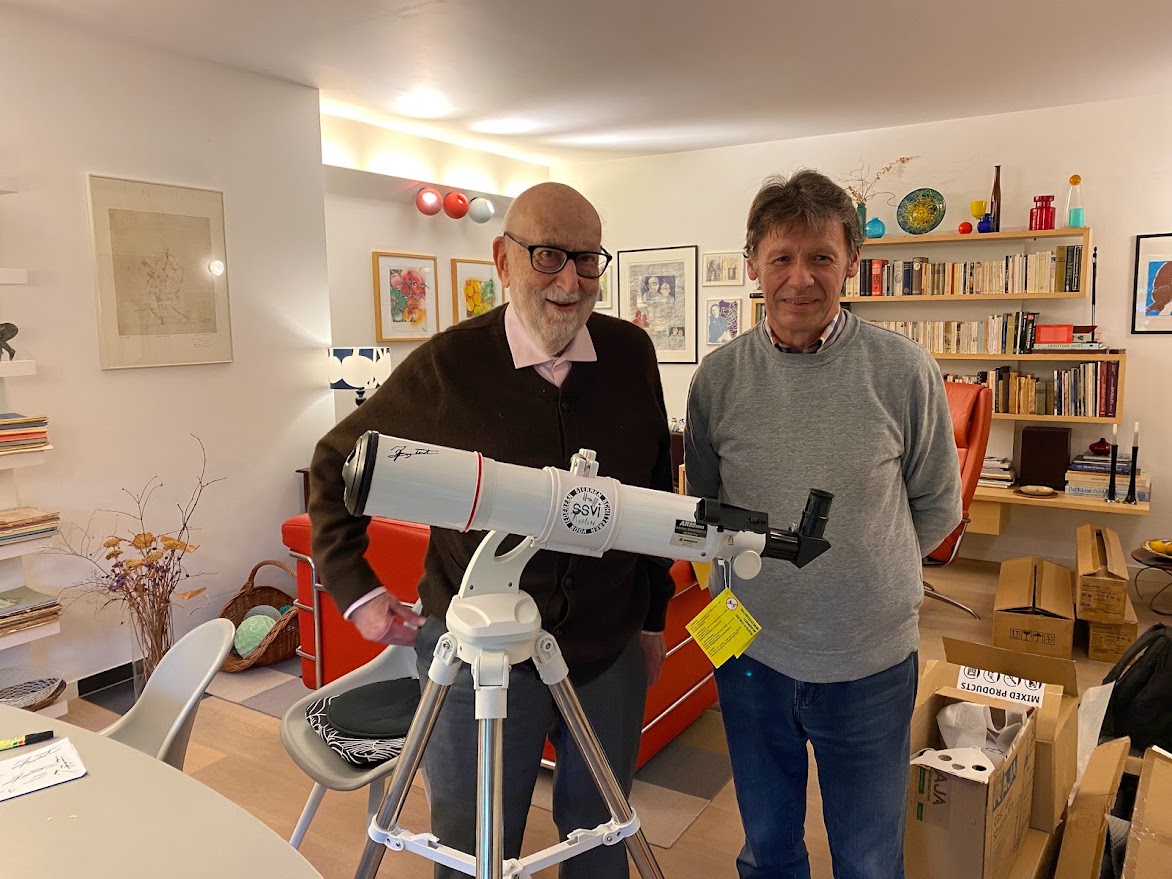
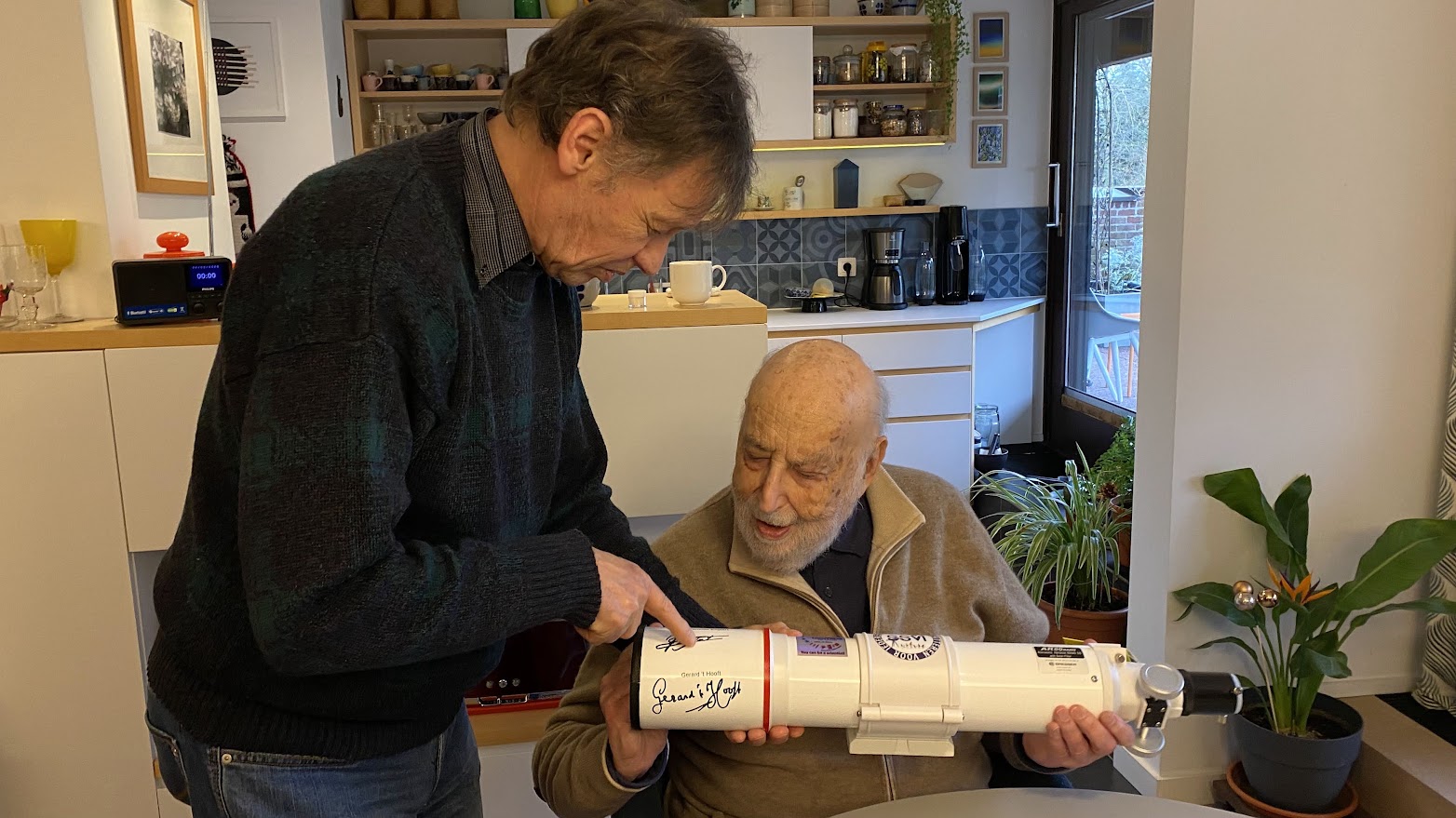
The book was Thieme's Sterrenboek, written by Bruno Ernst. Half a century later, Grootaerd would meet its author.
That combination of building and discovering for yourself would later become a recurring theme throughout his work. Grootaerd grew into one of the driving forces behind the Telescope-Building Group of the UGent Armand Pien Observatory. There, building telescopes became not only a technical activity, but also a way of bringing people closer to science.
Today, Grootaerd is associated with the Department of Physics and Astronomy at Ghent University and with the UGent Armand Pien Observatory. He is also the founder of SSVI.
A meeting that changed everything
According to Grootaerd, the idea for SSVI received an important impulse during a visit in August 2014 to the Dutch astronomer and science populariser Bruno Ernst. Grootaerd later described Ernst as his "astronomical father"; Looking back, he wrote that the idea for SSVI was born during that encounter.
The idea behind the project was simple, yet ambitious:
Every child should have the opportunity to look at the night sky through a telescope.
This principle became the foundation of Sterren Schitteren Voor Iedereen, internationally known as Stars Shine For Everyone, or SSVI. The project is an astronomical initiative aimed at children with disabilities and communities that have less access to resources and science education.
From Ghent to the world
What began as an initiative within the amateur astronomy community in Ghent gradually grew into an international project.
SSVI is based on the conviction that a telescope can be much more than an instrument for looking at the Moon or planets. It can also be a means of stimulating curiosity, encouraging scientific questions and actively engaging young people with science.
As of 2026, the project is active in more than 192 countries, across all continents. SSVI works with organisations and local groups that can use the telescopes for educational and outreach activities. From the early days onward, telescopes were sent to groups outside Belgium. Focus and WTV, for example, reported on telescopes being sent to institutions and organisations in places including Minsk and Cairo. Children and young people with disabilities are also among the project's target groups.
Telescopes as gifts
An important part of the story is the cooperation with companies and organisations that provide equipment and materials.
Bresser supplies telescopes and accessories for the project. In 2026, for example, Grootaerd reported that Bresser had donated 30 Messier AR102/135 telescopes, including accessories and solar filters, to SSVI. Among the conditions for recipients is that they build their own telescope mount according to a design developed by the Telescope-Building Group.
This principle fits perfectly with the philosophy with which Grootaerd himself began: not simply to give someone a telescope, but also to let people understand how a telescope works and how to observe with it.
"SSVI in a Box"
This educational approach also took shape in SSVI in a Box. The package was developed for schools and contains materials that allow students to work hands-on with telescopes, spectroscopes andother astronomical equipment.
Students learn, among other things, what a focal point is, how refracting and reflecting telescopes work, and how to align a reflecting telescope. They also practise practical skills such as assembling equipment, working systematically and making accurate observations.
The project was developed in cooperation with ESERO Belgium. In the official documentation, Jean-Pierre Grootaerd is credited with the concept, development and organisation of the project.
This makes an important aspect of his vision clear: astronomy does not have to be limited to looking at beautiful photographs of distant galaxies. You can literally put science in your own hands.
Astronauts as ambassadors
Over the years, SSVI has received support from well-known figures in the world of space exploration.
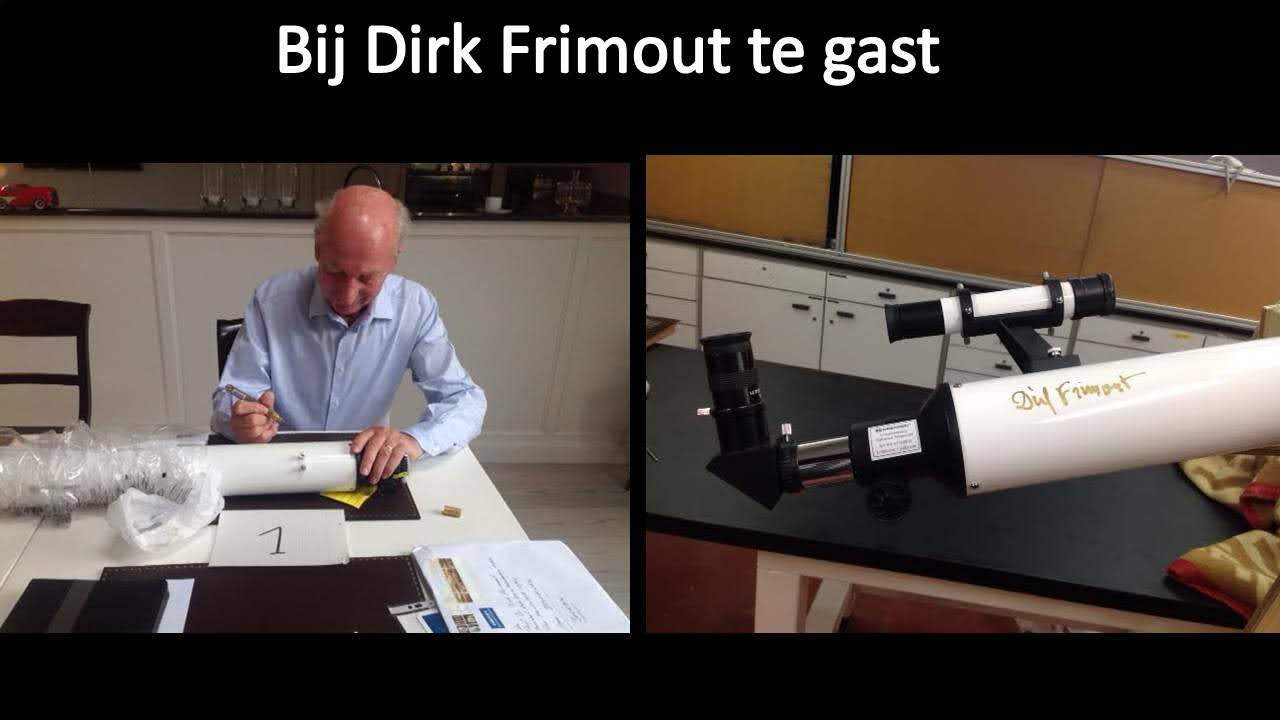
Belgian astronauts Dirk Frimout and Frank De Winne are mentioned by SSVI as supporters of the project.
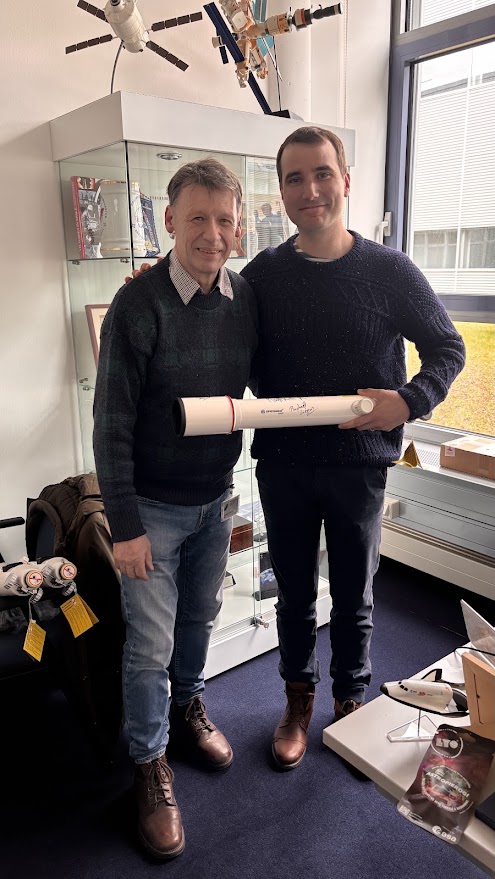
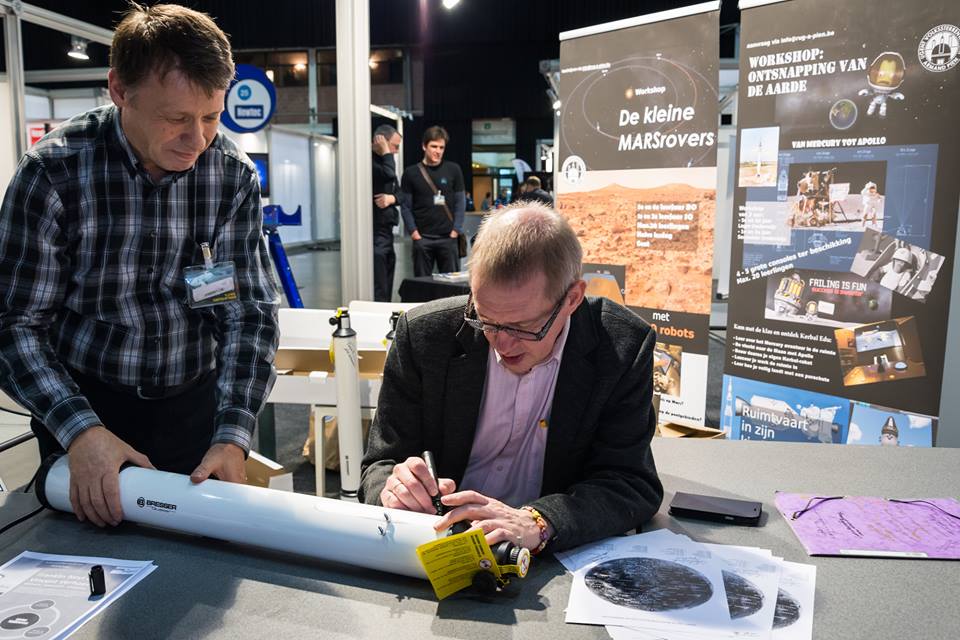
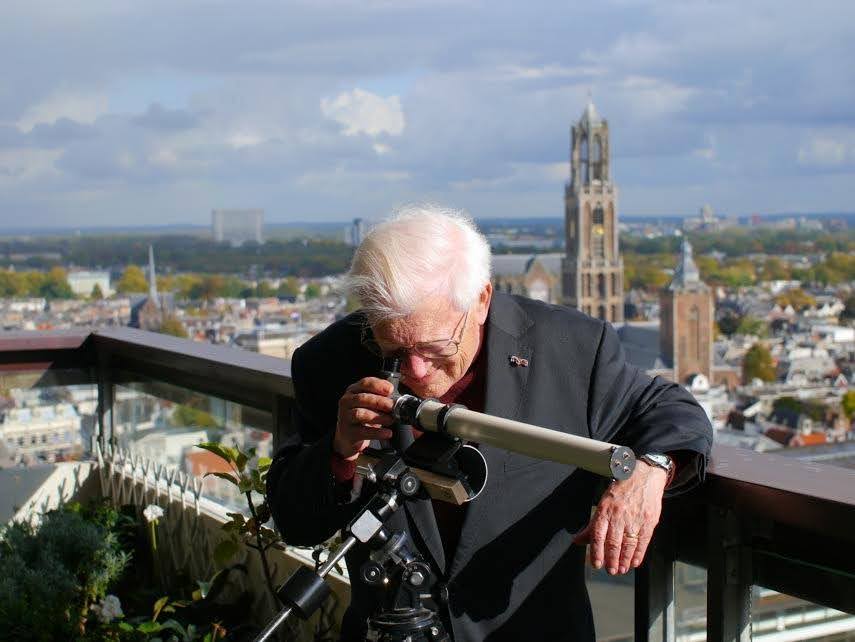
Grootaerd also regularly has telescopes signed by astronauts and other renowned scientists. These signed telescopes are subsequently used as part of SSVI activities. A report from 2018, for example, describes how astronauts André Kuipers, Thomas Reiter and Paolo Nespoli signed telescopes for SSVI.
Dozens of astronauts and Nobel laureates would follow.
The signatures are more than just a curiosity. They symbolise the connection between people who dream of space exploration and the young people who are looking through a telescope at the sky for the very first time.
SSVI and CERN
In the meantime, the project has grown beyond simply distributing telescopes.
One example is its cooperation with CERN, the European laboratory for particle physics. In 2023, Grootaerd wrote that SSVI was involved in CERN's international Beamline for Schools competition. Telescopes were made available for the anniversary edition, among other forms of support.
SSVI has also organised a multi-day CERN visit for teachers and educational professionals from Flanders and the Netherlands. The programme included visits to scientific facilities, lectures and educational activities.
In this way, SSVI gradually acquired a broader meaning: not only teaching people to observe the stars, but also bringing young people and teachers into contact with science, technology and space research.
The power of volunteers
Behind the international story lies a remarkable amount of volunteer work. The telescopes are built and adapted by the Telescope-Building Group of the UGent Armand Pien Observatory. The project also relies on material partners, donors, educational organisations and local groups.
In 2023, Grootaerd himself pointed out that the scale of the project was continuing to grow. Hundreds of applications were being received through various international astronomy initiatives, while the costs of wood, bolts, screws, springs and, above all, shipping had risen considerably.
From2024 onwards, SSVI also had to cover the shipping costs itself. The success of SSVI therefore brought a new challenge at the same time: how can an initiative that relies largely on voluntary commitment continue to grow?
More than a telescope
Perhaps the most remarkable thing about the story of Jean-Pierre Grootaerd is that, ultimately, it is not really about telescopes. A telescope is the visible result. The real goal lies behind it: to awaken curiosity.
When a child sees the craters of the Moon for the first time, they do not simply see an image. They may begin to wonder why the Moon has craters. How far away the Moon actually is. Why planets move. How stars are formed. Whether life exists elsewhere in the universe.
That is precisely where the power of science education lies: one observation can be the beginningof dozens of questions. This also explains why the motto of SSVI is so simple:
Stars Shine For Everyone.
The night sky belongs to no one — and at the same time, it belongs to everyone.
A childhood dream that kept growing